The Long Journey to Conserving Willapa Bay
Over 4,000 acres. That’s how much land Forterra has helped conserve in the Willapa Bay estuary, one of the most biologically productive estuaries in the United States.
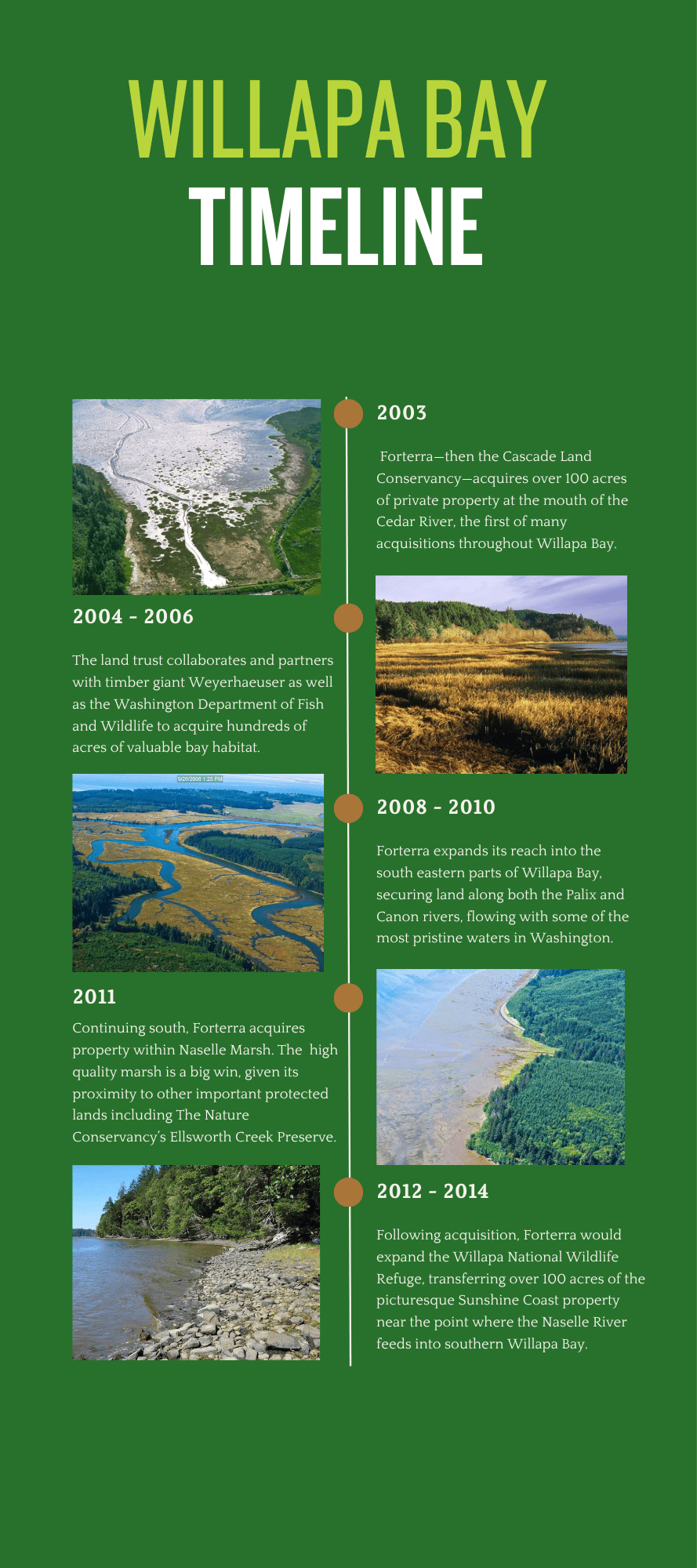
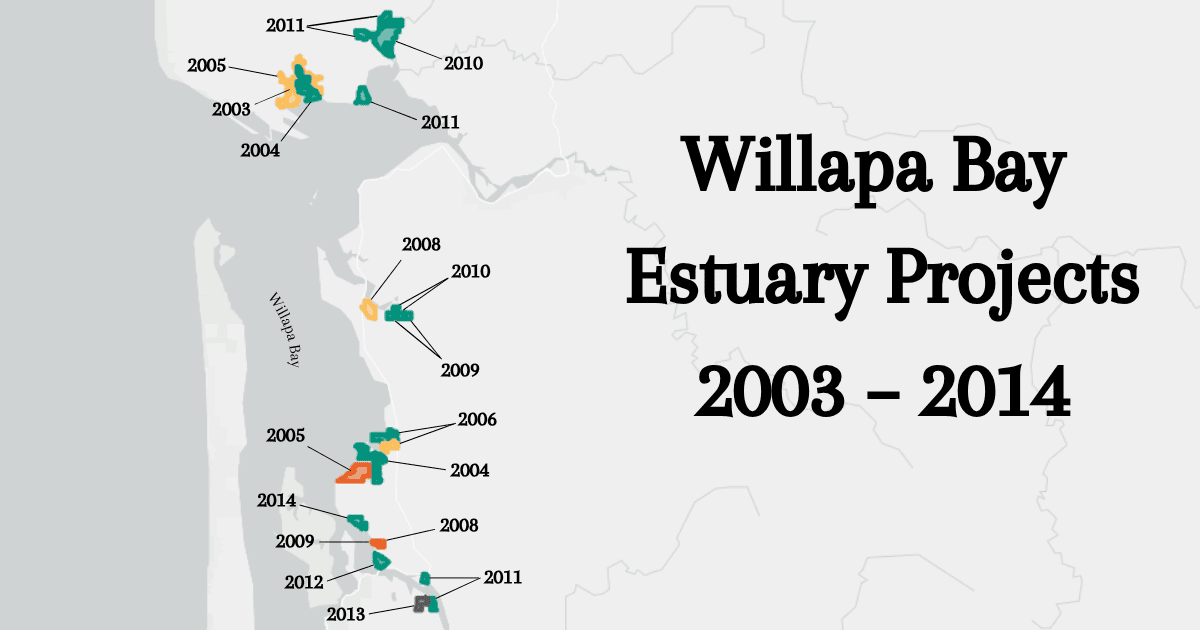
Yet it didn’t happen all at once. In fact, it was parcel by parcel, acquired over a decade of dedication and multiple partnerships.
Over 20 years ago, Forterra—then the Cascade Land Conservancy—purchased its first parcel in the bay, kicking off Phase I of its Cedar River Estuary acquisition plan. Cedar River empties into Willapa Bay from the north, where a tidally influenced ecosystem contains salt marshes, tidelands, and a mixed cedar, western hemlock, and Douglas-fir forest. The estuary provides valuable nursery habitat for several species of salmonid and is also a critical rest stop along the Pacific Flyway for 70 species of migrating shorebirds, waterfowl, and other avian species.
The acquired property, Oyster Island, was a mere 100 acres of shoreline along Willapa Bay, the second largest estuary on the Pacific Coast encompassing over 260 square miles of water surface. But it was a start.
The initial success was followed by several other acquisitions the following year. The Nemah River project, which included 305 acres of critical habitat for an array of bird, fish, and terrestrial species, was ranked number one in the National Coastal Wetlands Conservation Grant Program for 2004.
While several of Forterra’s first properties were purchased from individual private landowners, its continued success relied on collaborations with larger entities. In 2005, Forterra acquired over 500 acres of shoreline properties from one of the largest timber holding companies in the world. The Weyerhaeuser acquisitions were significant additions to the piecemeal estuary plan, particularly the 375 acres within close proximity of Willapa National Wildlife Refuge.
Over the next two years, the land trust would partner with the Washington Department of Fish and Wildlife (WDFW), which would eventually take on long-term stewardship to maintain and protect the estuarine and forested wetlands as part of the Willapa Bay Management Plan.
Yet it didn’t happen all at once. In fact, it was parcel by parcel, acquired over a decade of dedication and multiple partnerships.
Over 20 years ago, Forterra—then the Cascade Land Conservancy—purchased its first parcel in the bay, kicking off Phase I of its Cedar River Estuary acquisition plan. Cedar River empties into Willapa Bay from the north, where a tidally influenced ecosystem contains salt marshes, tidelands, and a mixed cedar, western hemlock, and Douglas-fir forest. The estuary provides valuable nursery habitat for several species of salmonid and is also a critical rest stop along the Pacific Flyway for 70 species of migrating shorebirds, waterfowl, and other avian species.
“If you drive along the coast of the Olympic Peninsula (Sunh-a-do) through Willapa Bay and look for impossibly pristine wetlands where rivers meet the sea in a gentle collision of saltwater and freshwater life, there’s a good chance you’ll be looking at an estuary protected thanks to the Forterra cowboys.”
– Topher Donahue, excerpt from
Forterra – Land for People. Land for Nature. Land for Good.™
Chetlo Harbor became the focus of attention in the years between 2012 and 2014. Once again, Forterra’s relationship-building enabled it to purchase land from Hancock Timber Resource Group, now rebranded under Manulife Investment Management.
Only a few miles inland from the harbor, 120 acres came into the Forterra fold, another big win for wildlife: the property contains Smith Creek, a tributary of the Naselle River and a salmon spawning stream. The property was also identified by WDFW as a priority habitat for Roosevelt Elk.
Today, Forterra continues its work acquiring important estuarine land throughout Washington, including properties within Grays Harbor and the 2,700 square-mile river drainage system that comprises the Chehalis River Basin. Acquisitions are oftentimes little by little and take time and multiple partners, but it’s all worth the effort.